Every generation of technology reflects the limits of its time.
For decades, investment technology evolved under the gravity of constraint: limited data, manual workflows, human-only analysis, and fragmented systems. We built tools to cope with those limits. We digitized documents. We automated tasks. We made legacy processes faster.
But we rarely asked the most important question: What kind of investment world are we actually trying to create?
In 2026, that question can no longer be deferred. AI, scalable data infrastructure, and compounding investment complexity have brought InvestTech to an inflection point. For the first time, the industry is no longer forced to optimize within inherited limitations.
For the first time, we get to choose.
The World We Inherited
Most investment firms still operate in a landscape shaped by necessity, not intention. It is a world where:
- The “why” behind critical decisions lives only in people’s heads.
- Prior diligence sits in stagnant folders instead of informing today’s work.
- Insights evaporate into the “PDF graveyard” of emails and spreadsheets.
- Knowledge compounds in individuals, but vanishes from systems when people leave.
No one designed this world; it emerged as a byproduct of the tools available. Over time, those constraints became invisible, and firms accumulated a costly, unseen liability: Intelligence Debt.
Intelligence Debt Meets Reality
Intelligence Debt builds quietly. It forms when knowledge is trapped in unstructured formats, when decisions are treated as one-time tasks instead of learning cycles, and when insights can’t connect across managers, strategies, or time.
The cost isn’t just inefficiency; it’s lost context. It’s the inability to recognize patterns. It’s a decision that should have been better, if only the system remembered what the firm once knew.
For years, firms could afford this. Alpha covered the friction. But the environment has shifted:
- Performance is under pressure.
- Operational complexity is non-linear.
- Access is no longer a moat.
- Markets are volatile.
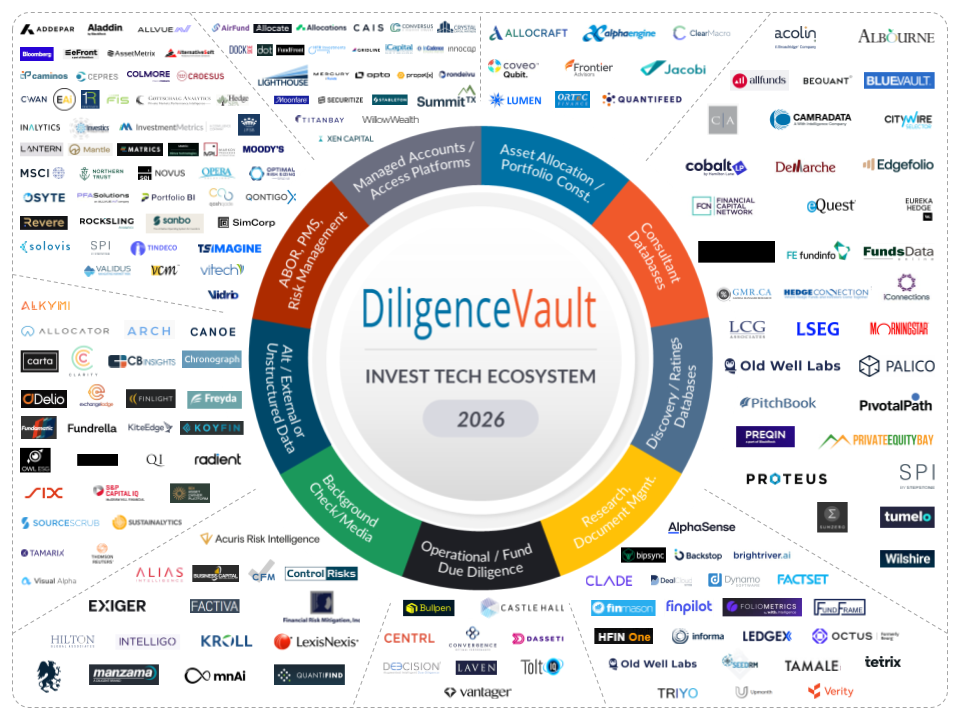
In a world of universal access, proprietary intelligence is the only durable differentiator. And then AI arrived. In response, the InvestTech ecosystem dynamism went up a notch with M&A, partnerships, and dozens of new launches.
Check Out the Latest Map Below:
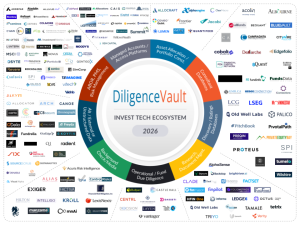
If your firm name is missing, please email marketing@diligencevault.com for inclusion.
AI Didn’t Break the System. It Revealed It.
Over the last two years, the promise was total: AI will read everything, answer everything, and accelerate everything. Firms rushed to deploy copilots and agents. Some of it worked; much of it impressed.
But AI didn’t eliminate Intelligence Debt. It exposed it.
- When an AI hallucinates, it’s often not a model failure. It’s an AI architecture problem, or a thin wrapper problem.
- When it can’t connect this year’s diligence to the last vintage, that’s not a reasoning gap, but it’s a data and memory gap.
- When outputs are unverifiable, the issue isn’t intelligence; it’s trust.
AI gives you velocity, but velocity only compounds when it’s grounded in conviction. That starts with a solid data foundation. It continues with an AI architecture that has measured delegation, continuously learns, is personalized to each firm, and which puts humans in the driver’s seat (at least until AGI shows up :).
For InvestTechs, Leapfrogging Is the Baseline
What the InvestTech landscape shows us today isn’t just innovation; it’s a category-wide leapfrog.
The distinction is no longer who has AI, but who has AI in production. Features are converging into “table stakes”:
- Automated Data Extraction is replacing manual managed services.
- AI-Assisted Memo Writing has moved from novelty to necessity.
- Continuous Risk Detection is replacing periodic reviews.
But while underlying models and features are converging, AI architecture will diverge in the form of output quality.
When Everything Is Possible, Choice Matters More
As AI capabilities expand, the “buying” process has actually become more difficult. Buyers are looking past the demo and asking:
- Which of these tools will be a commodity in twelve months?
- Should our intelligence live in point solutions, or a shared backbone?
- Are we buying a tool, or are we investing in infrastructure?
The answer for the modern firm isn’t “build everything” or “buy everything.” It is choosing platforms that can absorb change in the form of new models, new agents, and new workflows without breaking the way intelligence is stored, governed, and trusted.
The World We Can Create
In the world ahead, intelligence compounds. An analyst evaluating a GP doesn’t search folders. She sees a timeline of prior evaluations, resolved concerns, and strategic shifts easily. The system understands managers as evolving entities, not static documents.
Two firms can ask the same ESG question and get different answers: one focused on climate, the other on governance. This is not because one AI is “smarter,” but because the system honors the unique values and historical judgment of the firm using it.
In this world, AI reasons and surfaces signals, but humans apply conviction and make decisions.
Why This Matters to Us at DiligenceVault
At DiligenceVault, this moment feels personal. For over a decade, we’ve worked alongside teams trying to preserve institutional memory and reduce the intelligence debt that quietly erodes value.
What began as a diligence network has evolved into an intelligence digital backbone with 20,000 firms. The shift we’re seeing reinforces our core belief: the future belongs to those with the strongest foundation.
The world we can create is one where intelligence compounds on this data foundation instead of disappearing. Where speed is matched by trust, and scale by nuance. Where systems turn today’s work into tomorrow’s advantage.
That is the world we can create. And for the first time, we have everything we need to build it.
And this future is worth building!