What the 2025 Global Manager Survey reveals about why 780+ asset managers are finally hitting a breaking point, and what high-performing IR teams are doing differently.
What Is Digital Debt in Asset Management?
Picture this: It’s 6:00 PM on a Friday. A new DDQ just landed in your inbox.
You open it. It’s 80% identical to the one you finished on Tuesday. But that remaining 20%? Bespoke enough to send you back into a shared drive you haven’t fully organized since 2022. You’re not managing assets. You’re managing chaos, and at this point, the chaos is winning.
This isn’t a productivity problem. It’s a structural one. And it has a name: Digital Debt, the accumulated cost of building faster workflows on top of fragmented, unmaintainable infrastructure.
What Does the 2025 Global Manager Survey Say?
DiligenceVault’s 2025 Global Manager Survey collected insights from more than 780 firms across 78 countries. The findings paint a picture that most IR and RFP professionals will find uncomfortably familiar.
The industry has been told for years that it’s entering a “Digital Era.” But what most firms actually did was take paper files and turn them into PDF files. That’s not digitization. That’s migration.
The result? A generation of IR teams that are faster, yes, but not smarter. Teams running harder on a treadmill that was never designed to get them anywhere.
What Are the Biggest Challenges Facing IR and RFP Teams in 2025?
The survey’s 17 questions reveal three inflection points that matter most for IR and RFP leaders right now.
1. Can Asset Managers Use AI if They’re Still Running on Shared Drives?
The short answer: no. And the data confirms it.
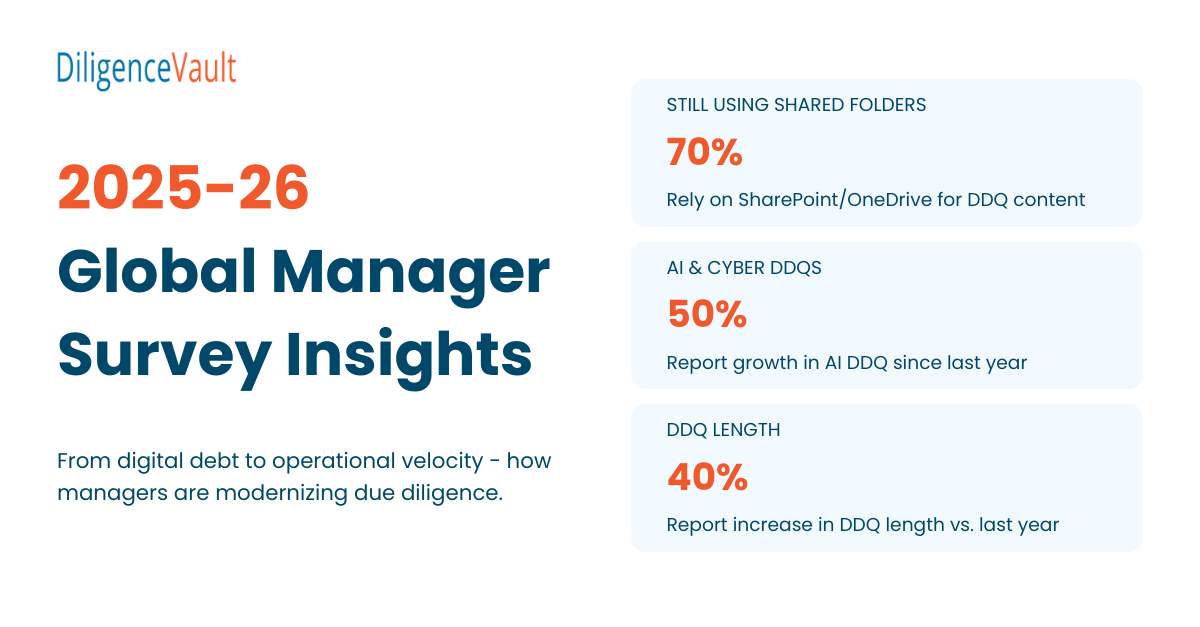
70% of managers are still primarily operating off shared drives. Shared drives aren’t infrastructure. They’re institutional memory trapped behind folder structures that only one person fully understands, and that person might be out sick, on vacation, or no longer at the firm.
Meanwhile, every conference panel is asking: “Are you using AI in your IR process?” The honest answer for most teams is: “We’d like to. But you can’t feed a shared drive to an AI.” You can’t prompt-engineer your way out of a PDF graveyard.
The shift happening at forward-looking firms: moving from Files to Flow, replacing folder hierarchies with Centralized Content Libraries where data is structured, searchable, and machine-readable from day one.
2. Is DDQ Standardization Actually Working?
Yes, and the momentum is real.
Standard DDQ acceptance has surged to 38%. Allocators are increasingly willing to accept standardized formats. Smart IR teams are reading this correctly: standardize the table-stakes 80% so your human attention can focus on the 20% that actually differentiates you.
The Wealth and Retail channels are opening up, bringing enormous volume opportunities. But these channels demand data throughput that bespoke, manual workflows simply cannot sustain. The firms still insisting on fully custom responses to every request aren’t being thorough. They’re being slow. And in a world where mandates go to teams that respond fastest without sacrificing quality, slow is a liability.
3. What Are Allocators Actually Asking About in 2026?
ESG and DEI scrutiny hasn’t disappeared, but the survey shows it has stabilized. What’s exploding in its place? AI Governance and Cybersecurity inquiries, with 50% of managers reporting a significant increase.
The DDQ of 2026 won’t just ask “what is your ESG policy?” It will ask: “How is your data governed, and can our systems talk to yours?”
The next mandate you compete for may hinge not on your investment thesis, but on whether your data infrastructure is auditable, secure, and machine-readable when an allocator’s AI system comes looking for it.
Why Is IR Burnout So Common and Is It Actually an Infrastructure Problem?
Yes. And it’s worth saying plainly.
When your institutional memory lives in a shared drive or worse, in someone’s head or email inbox, every new request requires a “Search and Rescue” mission. You’re not just answering questions; you’re first finding the answers, validating they’re current, and hoping the file name still makes sense.
That’s not inefficiency. That’s a system that was never designed for the volume and velocity of modern allocator demands. We’ve asked IR professionals to perform at an institutional scale using consumer-grade organizational tools. The empathy gap is real, and the data shows the breaking point is here.
How Are High-Performing IR Teams Structuring in 2026?
The firms pulling ahead aren’t necessarily using different AI. They’re using better data foundations that allow AI to actually work. The practical model looks like this:
- A centralized content library – replaces the shared drive; every update flows through one source of truth, and nothing gets lost in a folder renamed by someone who left the firm two years ago.
- Standardization handles the repeatable 80% – populate Blaze Live Profile on DiligenceVault to free your team from the manual chase on table-stakes requests.
- AI bridges the bespoke 20% – surfacing relevant context, drafting responses, flagging gaps.
- SME collaboration becomes frictionless – portfolio managers, risk teams, and compliance no longer get pulled into last-minute email threads. The right experts are looped in at the right moment, with the context they need already in front of them.
- IR professionals shift from Data Gatherers to Strategy Narrators – spending their expertise on the nuanced, differentiated story only they can tell.
The goal isn’t to automate IR. It’s to give IR teams back the headspace to do what they’re actually best at and to stop making subject matter experts feel like they’re being ambushed every time a DDQ deadline looms.
What Will Give Asset Managers a Competitive Edge in 2026?
The technology is almost never the bottleneck. The data is.
The firms that win the allocator’s nod in 2026 won’t necessarily have the secret sauce AI. They’ll have the most accessible, accurate, machine-readable institutional memory firms where an allocator’s diligence system can find what it needs, in the format it needs, without a human having to intervene.
That’s not a technology story. That’s an operational discipline story. And it starts with a decision to stop accumulating Digital Debt and start building a Data Bridge.
Take the Next Step
The manual era is ending. The 2025 Global Manager Survey whitepaper shows exactly what’s replacing it and where your firm stands today.
Choose your path forward:
📄 Download the Full 2025 Global Manager Survey Whitepaper: Get the complete data and a practical framework for prioritizing the infrastructure changes that will matter most for your firm.
⚡Try DiligenceVault’s AI – See It Live: See what it looks like when your institutional memory is structured, searchable, and ready for the next DDQ that lands on a Friday at 6:00 PM.
Signup below to download the PDF.